The short answer
Most problems with high-end ranges, such as burners that won't light, ovens that won't heat, and error codes, come from a single replaceable part like an igniter, sensor, spark module or control board. A technician can usually find the cause in one visit and repair it for much less disruption than replacing a built-in range.
When a professional-style range stops lighting, runs the oven at the wrong temperature, or shows an error code, cooking at home stalls. We repair gas, dual-fuel and electric ranges in homes across Van Nuys, Sherman Oaks, Encino, North Hollywood, Studio City and nearby San Fernando Valley communities. Many homeowners know us for Sub-Zero refrigeration, and a lot of those kitchens pair the refrigerator with a Wolf range. We also service Viking and Thermador ranges. We are an independent repair company and are not affiliated with any of these brands. Our goal is simple: find the actual fault, explain it in plain terms, and fix it correctly.
Issues we fix
These are the symptoms homeowners describe most often. If you notice more than one, write them all down before your visit. Combinations of symptoms help narrow the cause.
Safety first: if you smell gas, don't operate the range or any switches. Leave the house and call your gas utility from outside. Call us once the leak has been addressed.
- Burners that click but won't ignite, or keep clicking after the flame is lit
- Flames that are yellow, uneven, lifting off the burner, or too low on simmer
- Oven that won't heat, heats slowly, or shuts off partway through preheat
- Oven temperature that runs hot or cold, or bakes unevenly
- Broiler or infrared broiler that won't light or won't glow
- Convection fan that is noisy, slow, or not running
- Error codes, blank displays, or controls that won't respond
- Self-clean door lock stuck closed or not engaging
- Oven door that won't seal, sags, or closes unevenly
- Stiff or loose control knobs and worn burner caps or grates
What our technician checks on a built-in or professional-style range
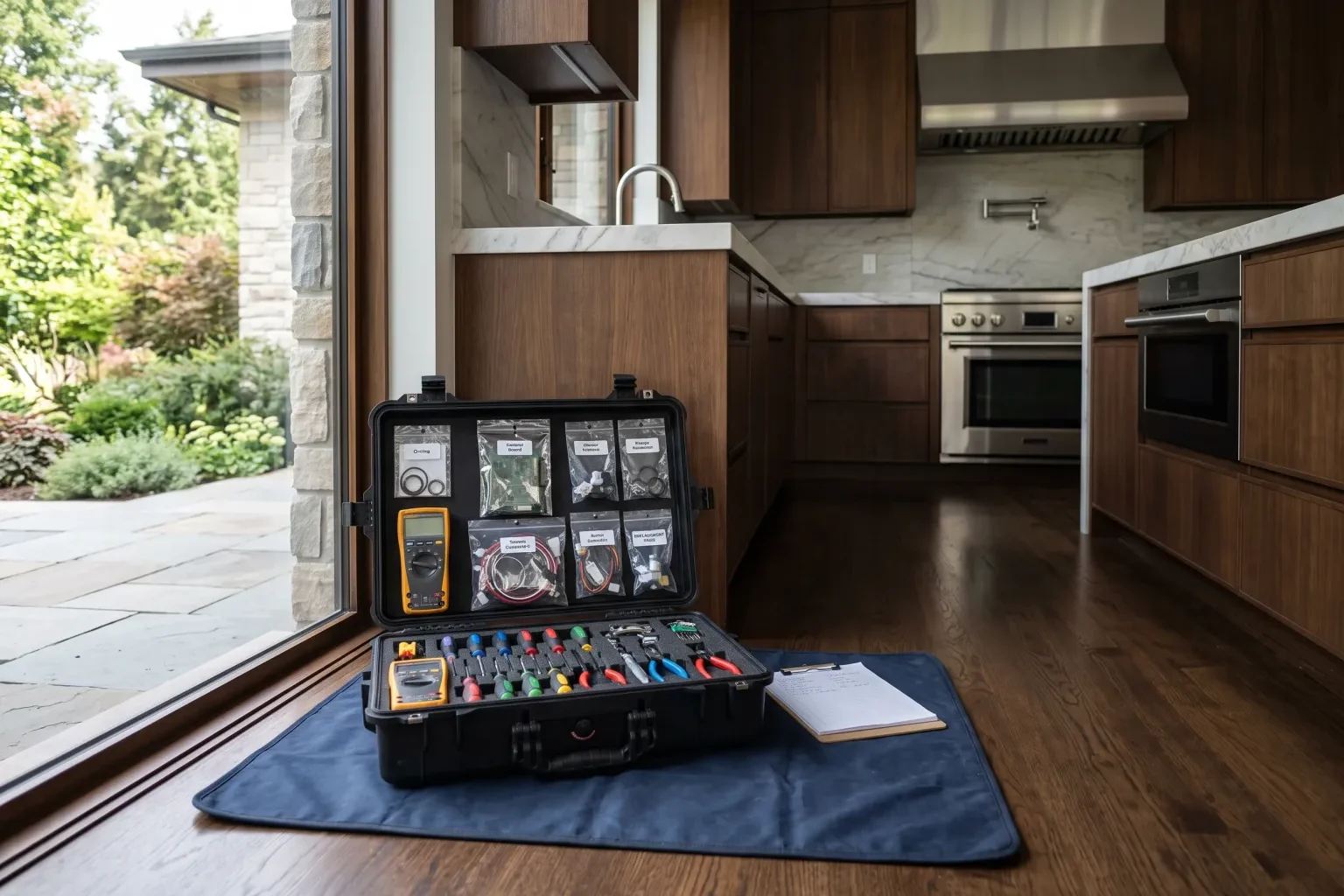
We start with the symptom and test the parts that could cause it. We don't swap parts until something works. On the cooktop, that means inspecting burner caps and ports for blockage or misalignment, checking each spark electrode and its gap, and testing the spark module and igniter switches behind the knobs. If a burner won't hold a low flame, we check the valve and simmer setting.
In the oven, we measure the igniter on gas models, since a weak igniter can glow without opening the safety valve. On dual-fuel and electric ovens, we test bake, broil and convection elements. We check the temperature sensor's resistance, the control board's outputs, relays and wiring, the convection motor, the cooling fan, door hinges and the gasket. When the repair is done, we verify actual oven temperature rather than trusting the display.
Built-in and freestanding professional ranges are heavy, and they usually sit tight against custom cabinetry and stone counters. When a range needs to be pulled forward, we protect the floor and cabinet faces, disconnect power and gas safely, and reconnect and leak-check afterward. We also confirm the anti-tip bracket is reinstalled.
How Wolf, Viking and Thermador ranges differ
Sub-Zero focuses on refrigeration, while Wolf is its sister brand for cooking. That's why so many Sub-Zero kitchens have a Wolf range. Wolf ranges use dual-stacked sealed burners, and many models are dual-fuel, combining gas burners with an electric convection oven. On these units, the issues we look for first are spark igniters and spark modules, oven temperature sensors, convection fan motors and electronic controls.
Viking ranges follow a heavier, commercial-style design. Gas ovens rely on igniters that weaken over time, which shows up as slow preheating or an oven that won't light. Door hinges and springs on these large, heavy doors also take wear, along with burner igniters and knob assemblies.
Thermador ranges are known for star-shaped burners and very low simmer settings. Problems often involve spark igniter switches, burners that cycle on low settings, and electronic oven controls on newer models. Every brand has its own parts and wiring layouts, so we come prepared with the model in mind.
Tell us what your appliance is doing.
Repair or replace?
High-end ranges are built to be serviced. Most failures involve a single component, and replacing that part brings the range back to full function. For a built-in or professional-style unit that fits your cabinetry and kitchen layout, repair is usually the practical choice.
Replacement is worth considering when the oven cavity or burner box is cracked or badly corroded, when a needed control board is no longer available, when several major systems fail at once, or when you're remodeling anyway. Keep in mind that a new range may not match your existing cutout, gas connection or electrical supply exactly. We'll tell you what we find and give you a straight answer, so you can make the decision with the facts in front of you.
What affects the cost of range repair
We won't quote a figure before we've seen the range, because the same symptom can have very different causes. These are the main factors:
- The fault itself: a clogged burner port or loose connection takes far less work than a failed control board or gas valve
- Parts: brand-specific components vary widely, and some must be ordered
- Access: ranges set into custom cabinetry, islands or tight stone surrounds take more time to pull out and reinstall safely
- Number of problems: older ranges sometimes have a second worn part that shows up during testing
- Return visits: if a part isn't on hand, we'll need to come back to install it
How a visit works
When you book, tell us the brand, the model and serial number if you can find them, and what the range is doing. The model tag is often behind a drawer or kick panel, or along the oven door frame. This helps us bring the right parts.
Our technician checks the symptoms, tests the likely components and explains what failed before starting any work. If the part is on hand, we usually repair it during the same visit. If it needs to be ordered, we schedule the return. Before leaving, we test every burner, run the oven, check the temperature and clean up the work area.
Range Repair by city
-
 Range Repair in San Fernando
Local service & repairs
-
 Range Repair in Burbank
Local service & repairs
-
 Range Repair in Beverly Hills
Local service & repairs
-
 Range Repair in West Hollywood
Local service & repairs
-
 Range Repair in Hidden Hills
Local service & repairs
-
 Range Repair in Calabasas
Local service & repairs
-
 Range Repair in Glendale
Local service & repairs
-
 Range Repair in Los Angeles
Local service & repairs
-
 Range Repair in Santa Monica
Local service & repairs
-
 Range Repair in Culver City
Local service & repairs
-
 Range Repair in Santa Clarita
Local service & repairs
-
 Range Repair in La Cañada Flintridge
Local service & repairs