The short answer
Most warming drawer problems come from a failed heating element, temperature sensor, thermostat, control board or drawer glide, and all of these can usually be repaired. On a high-end built-in unit, repair is usually worth it unless the cabinet itself is damaged or parts are no longer available.
A warming drawer is easy to forget until it stops working. Then plates go out cold, rolls dry out, or the drawer runs hot enough to scorch whatever is inside. We repair built-in and professional-style warming drawers for homeowners in Van Nuys and nearby San Fernando Valley neighborhoods, including Sherman Oaks, Encino, North Hollywood and Studio City. Many of the kitchens we work in are built around Sub-Zero refrigeration, with Viking, Wolf and Thermador cooking appliances alongside it. We are an independent repair company and are not affiliated with any of these manufacturers. Our job is to find out why your drawer is misbehaving and fix it properly, without pulling apart more of your cabinetry than we have to.
Issues we fix
Warming drawers have fewer parts than an oven, but the parts they do have work hard. They hold steady low heat for hours, and they open and close many times during a meal. These are the problems homeowners call us about most:
- Drawer does not heat at all, even though the indicator light comes on
- Drawer runs too hot and dries out or browns food
- Uneven heat, with one side or the back noticeably cooler
- Temperature drifts and does not hold the setting
- Touch controls or knobs do not respond, or the display is blank
- Error codes or flashing lights on electronic models
- Moisture or crisp settings that no longer change anything
- Drawer sticks, drops at the front, or won't close fully
- Push-to-open mechanism that has stopped working
- Breaker trips or a burning smell when the drawer turns on
What our technician checks on a built-in or professional-style unit
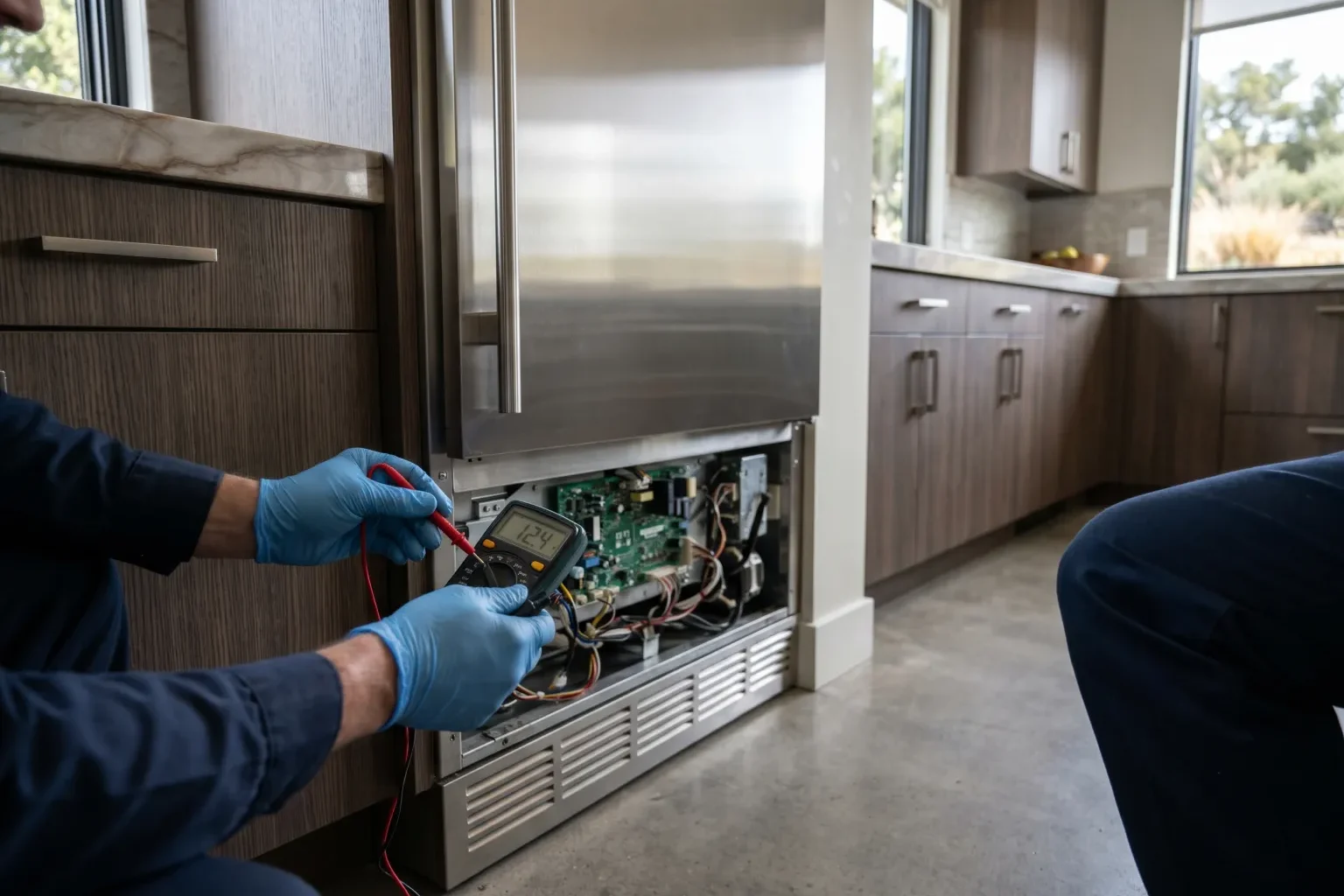
We start by confirming the problem you described and checking power at the drawer. A unit that seems dead sometimes has a tripped breaker, a loose connection or a door switch that is not making contact. Next, we measure the actual drawer temperature against the setting, because a drawer that feels "not hot enough" is sometimes running within its normal range for that setting.
From there we test the heating element for continuity and resistance and check the temperature sensor or thermostat against its expected readings. We also look at the high-limit safety cutout, the wiring harness and the control board or switches. On drawers with moisture control, we check that the vent or damper opens and closes. We inspect the glides, rollers and drawer gasket, since a poor seal or a sagging drawer front lets heat escape and can look like a heating failure.
Whenever possible we do this work from the front, with the drawer removed, so the unit can stay in its cabinet opening. We only pull a unit out of the cabinetry when the fault requires it.
How Sub-Zero, Viking, Wolf and Thermador drawers differ
Sub-Zero is a refrigeration brand, so in a Sub-Zero kitchen the warming drawer is usually a Wolf unit installed as part of the same suite. Wolf drawers are built to sit flush with Wolf ovens, and many have a humidity control. When that vent stops responding, food comes out either soggy or dried out. Their electronic controls and sensors also need to be tested together, because one bad part can make the other look faulty.
Viking warming drawers show up in both professional-style ranges and built-in wall configurations. Older Viking units with mechanical controls tend to fail at the thermostat, the element or the switch. Newer ones add electronic controls, so the diagnosis moves toward sensors and boards. Heavy drawer fronts also put real load on the glides.
Thermador drawers often come with push-to-open fronts and moisture settings. So along with the usual element and sensor checks, we look closely at the opening mechanism and the control panel, which take a lot of daily contact.
Across all four brands, the failure points are similar: heat source, temperature sensing, controls and the drawer hardware. What changes is how the parts are accessed and which ones are used.
Tell us what your appliance is doing.
Repair or replace a high-end warming drawer
Premium warming drawers are built into custom cabinet openings and matched to the ovens around them. Replacing one means finding a model that fits the same opening and still lines up with the rest of the kitchen, so repair is usually the better path. Elements, sensors, thermostats, glides and gaskets are all serviceable parts.
Replacement makes more sense when the inner cavity or housing is damaged, when the control board has failed and no replacement is available, or when several major parts have failed at once on an older unit. If we reach that point, we will tell you plainly and explain why, so you can decide with the facts in front of you.
What affects the cost
We don't quote prices before we see the unit, because the fault decides most of the cost. A loose connection or worn glide is a very different job from a failed control board. Parts matter too. Some components are commonly stocked, while others, especially electronic controls for discontinued models, take longer to find.
Access is the other big factor. A drawer that can be serviced from the front is simpler than one that has to come out of tightly fitted custom cabinetry or panel-ready trim. Once we have diagnosed the problem, we explain the repair and what it involves before any work begins.
How a visit works
When you contact us, we ask for the brand, the model number if you can find it (it is usually on a label inside the drawer opening or on the drawer side), and what the drawer is or isn't doing. That helps the technician arrive prepared.
At the visit, the technician diagnoses the unit, shows you what failed and walks you through the repair options. If the needed part is on hand, the repair can often be finished the same day. If it has to be ordered, we schedule a return visit to install it. Before leaving, we run the drawer at temperature to confirm it heats and holds properly, and we check that it opens and closes cleanly.