The short answer
Most wine cooler problems are repairable. The usual causes are a failing fan, a dirty condenser, a worn door gasket, a bad sensor or control board, or less often a sealed-system issue. A technician can diagnose a built-in unit in your home and tell you whether the repair makes sense before any work begins.
A built-in wine cooler is supposed to hold one steady temperature for years. When it starts running warm, cycling loudly, frosting over, or flashing a code, the bottles inside are what's at risk. We repair built-in and professional-style wine storage in Van Nuys and the surrounding San Fernando Valley, with a focus on Sub-Zero units. We also service Viking and Thermador wine columns and undercounter models. Wolf makes cooking equipment rather than wine storage, but many of the kitchens we visit pair a Wolf range with a Sub-Zero wine unit, so we know how these installations are laid out. We are an independent repair company, not affiliated with any of these brands. Our goal is to find the actual fault, explain it plainly, and fix it without tearing apart your cabinetry.
Issues we fix
Wine storage fails differently than a regular refrigerator. Small temperature swings matter more, and many problems show up gradually. These are the symptoms owners most often call us about.
- Not cooling, or holding a temperature several degrees above the setpoint
- One zone of a dual-zone unit running warm while the other is fine
- Temperature swinging up and down through the day instead of holding steady
- Frost or ice build-up on the rear wall or evaporator cover
- Water pooling inside the cabinet or on the floor, or a drain that won't clear
- Condensation on the glass door or around the frame
- Compressor running constantly, short-cycling, or not starting at all
- Loud buzzing, rattling, or clicking from fans or the compressor area
- Error codes, alarms, or a blank or unresponsive control panel
- Interior lights out or flickering
- Door not sealing, not closing on its own, or a torn gasket
- Humidity problems, such as dried-out corks or a musty smell
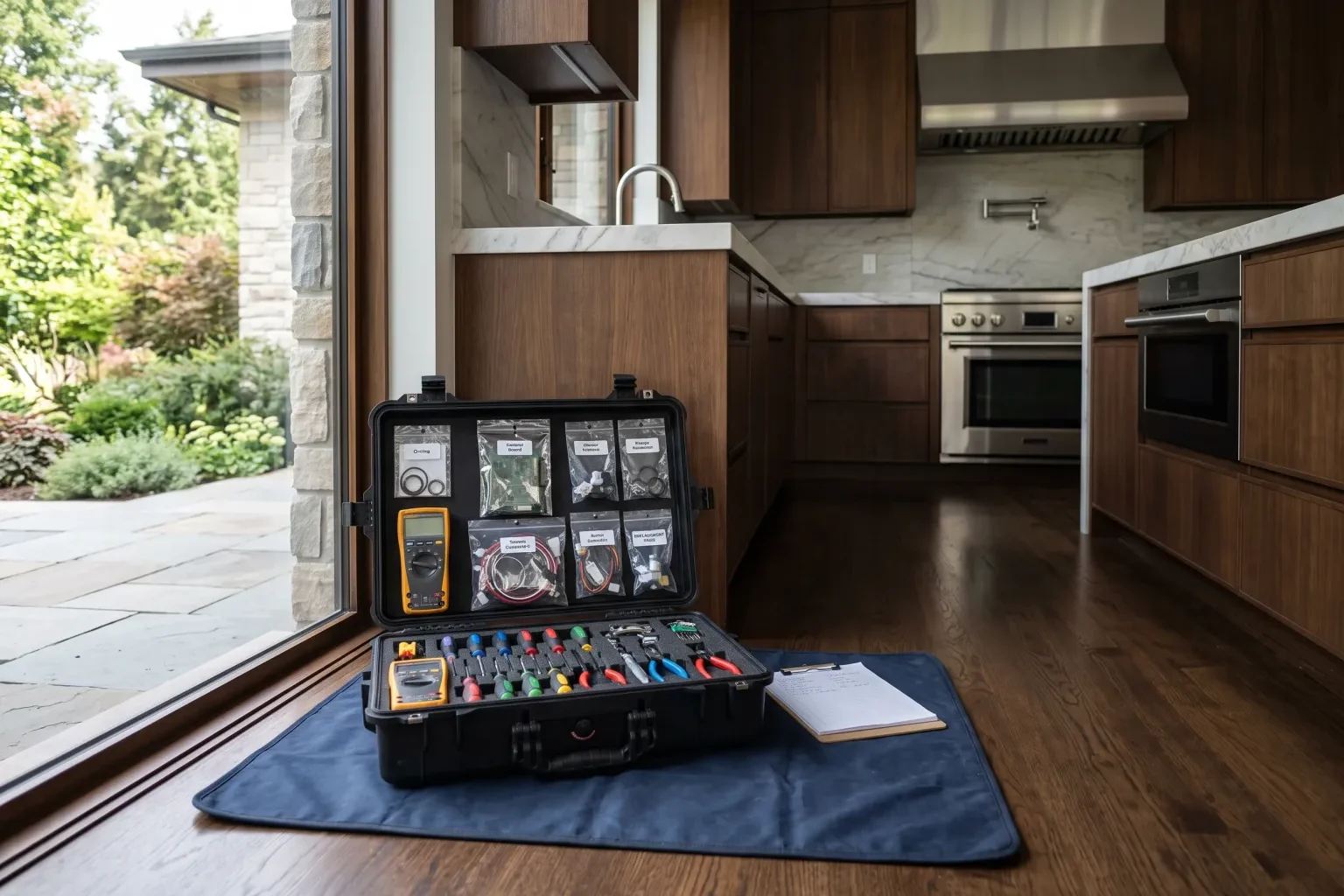
What our technician checks on a built-in unit
Built-in and professional-style wine units are designed to vent from the front, so airflow and the condition of the front grille matter a great deal. We start there. We check the condenser coil for dust and lint, confirm the condenser fan is spinning freely, and make sure nothing in the toe-kick or cabinetry is blocking air.
Inside the cabinet, we measure actual temperatures in each zone against the display, test the thermistors and sensors, and check the evaporator fan and defrost function. If there is frost or water, we look at the drain path, the drain heater where one is used, and the defrost cycle. We inspect the door gasket all the way around, check door alignment and hinge tension, and look for heat from the glass or frame heaters where the model uses them.
On the electrical side, we read any stored error codes, test the control board and user interface, and check the compressor start components. If those all check out and the unit still won't cool, we evaluate the sealed system for a refrigerant leak or compressor failure. In the Valley, summer heat is a real factor. Inland neighborhoods run much hotter than the coast, and fall Santa Ana winds bring hot, dry spells. A wine unit in a warm garage, bar area, or sunny room has to work harder, and we take its location into account.
How Sub-Zero, Viking, Wolf and Thermador units differ
Sub-Zero wine storage is built with separate temperature zones, and many models run long service lives. The repairs we see most often involve sensors, fans, control boards, and door gaskets. Because these units are installed flush in cabinetry, a clogged front grille or condenser is a common reason for warm temperatures. Sealed-system repairs are possible, but they are a larger job.
Viking wine coolers and columns often come to us with fan motor noise, control issues, and door seal problems. Thermador wine columns, often installed as part of a column refrigerator and freezer set, can show control or display faults, sensor problems, and airflow issues tied to tight installations. As noted above, Wolf doesn't build wine storage. If your Wolf range or oven also needs attention, we can look at it on the same visit.
Tell us what your appliance is doing.
Repair or replace a high-end wine cooler
For a premium built-in unit, repair is usually the better choice. Replacing it often means matching exact cutout dimensions, custom panels, and trim, and a new unit may not fit the existing opening. Fans, sensors, gaskets, defrost parts, and control boards are all repairable on most models.
Replacement becomes worth discussing when the compressor or sealed system has failed on an older unit, when parts for that model are no longer available, or when the cabinet itself is damaged. We'll give you our honest read on the unit's condition so you can decide with real information.
What affects the cost of a repair
The biggest factor is the fault itself. Cleaning a condenser or replacing a gasket is a much smaller job than a sealed-system repair. Parts are the next factor, since some components for premium brands are specific to a model and may need to be ordered.
Access matters too. A unit set deep into custom cabinetry, with integrated panels or tight clearances, can take more time to pull out safely and reinstall. We explain what we found and what the repair involves before starting, so there are no surprises.
How a service visit works
When you contact us, have the brand, model, and serial number ready if you can find them. They are usually on a label inside the cabinet. Tell us what you're seeing, along with any error codes. We'll schedule a visit at your home in Van Nuys or a nearby city.
At the appointment, the technician runs through the checks above, explains the problem, and outlines the repair. If the part is on hand, many repairs are finished the same visit. If it needs to be ordered, we'll tell you what to expect and come back to complete the job. Before we arrive, it helps to move valuable bottles to a cool, dark spot if the unit is running warm.