
The short answer
Most microwave drawer problems come from the drawer drive system, the door interlock switches, the touch control, or the high-voltage heating circuit, and most can be repaired without removing the unit from your cabinetry. A technician can test each system in place and tell you whether a repair is worth it before any work starts.
Many high-end kitchens in Van Nuys put a microwave drawer under the counter or into an island, often next to Sub-Zero refrigeration and a professional-style range. When that drawer stops heating, won't open, or ignores the touch panel, it disrupts the whole kitchen. We are an independent repair company that services premium appliances from Sub-Zero, Viking, Wolf and Thermador, and microwave drawers are a regular part of that work. Our technician diagnoses the unit where it sits, tells you what failed and why, and gives you a straight answer on whether repair makes sense. We serve homeowners in Van Nuys and the surrounding San Fernando Valley communities.
Issues we fix
A microwave drawer combines a motorized drawer with a high-voltage cooking system, so problems tend to fall into one of those two areas. These are the symptoms homeowners describe most often:
- Drawer won't open or close, or stops partway and reverses
- Grinding, clicking, or straining noise when the drawer moves
- Runs, lights up, and turns the fan, but the food stays cold
- Uneven heating, with hot edges and a cold center
- Touch panel doesn't respond, or only some keys work
- Error codes or a flashing display that won't clear
- Sparking, arcing, or a burning smell inside the cavity
- Unit is completely dead even though the breaker is on
- Interior light or cooling fan not working
- Drawer opens when you didn't touch it, or the control lock won't release
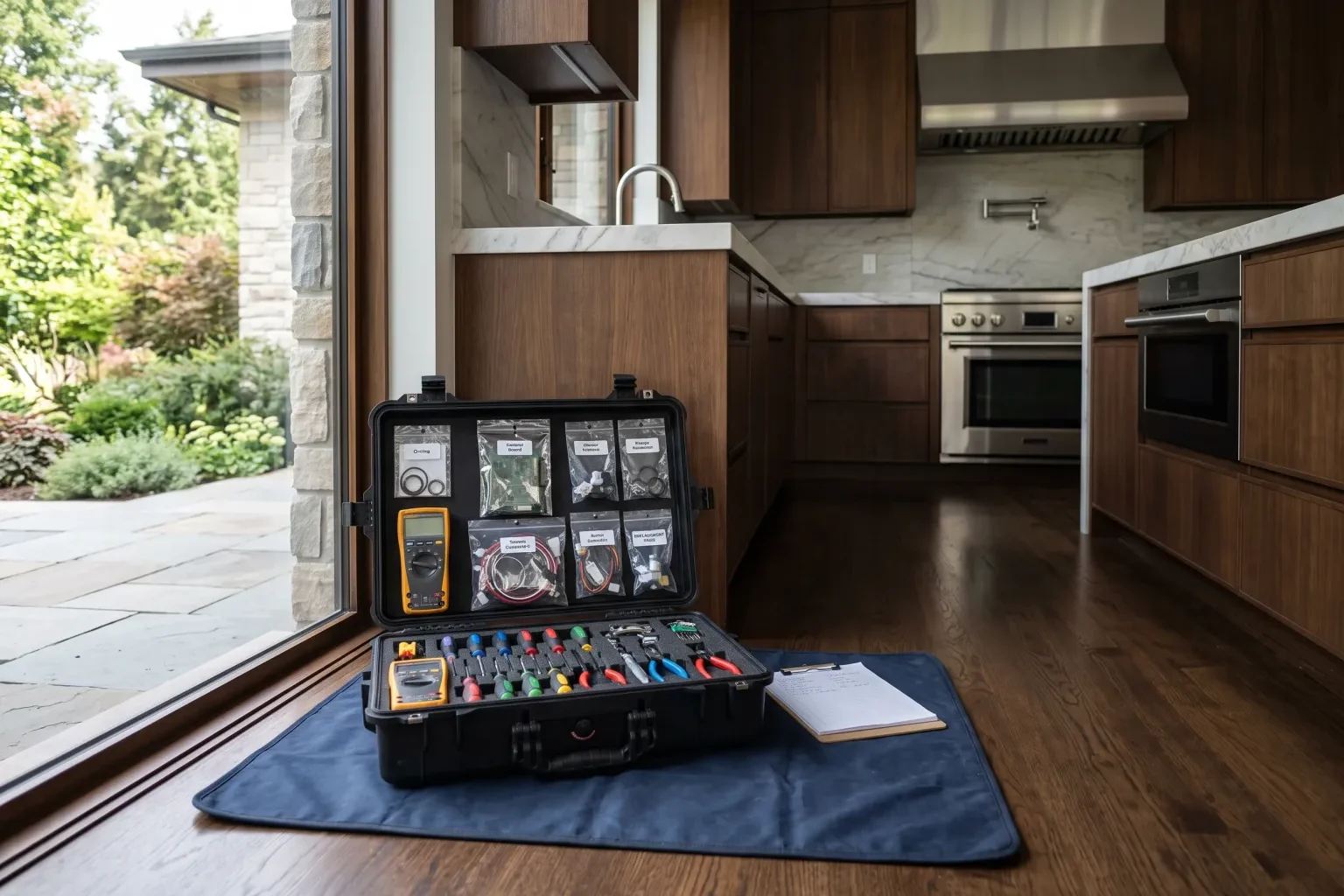
What our technician checks on a built-in unit
A microwave drawer stores a dangerous charge in its high-voltage capacitor even after it is unplugged. Please don't open the outer cabinet yourself. Our technician discharges the capacitor safely before testing anything inside.
On a typical visit, the technician works through the unit in order. First, the drawer itself: the drive motor, gear rack, rollers, and slides, plus the position and obstruction sensors that tell the control where the drawer is. A stripped gear or a sensor knocked out of alignment can make a drawer stop halfway or refuse to move.
Next come the door interlock switches. They have to read correctly before the unit will heat, and a worn switch can also blow the main fuse. After that, the technician tests the heating circuit, which includes the magnetron, high-voltage diode, capacitor, and transformer, then the control board and touch panel.
Built-in units add their own checks. The technician confirms the drawer is level and properly secured in its opening, that the dedicated circuit supplies the correct voltage, and that the unit has the ventilation clearance its installation guide calls for. Cabinetry that has shifted, or a cutout that is slightly off, can bind the drawer and wear out the drive parts over time.
How Wolf, Viking and Thermador drawers differ
Sub-Zero focuses on refrigeration and doesn't build a microwave drawer under its own name. Its sister brand, Wolf, makes the microwave drawer you'll often find in a Sub-Zero kitchen. Viking and Thermador both offer their own microwave drawers. The basic design is similar across all three: a drawer that opens and closes on its own, with the cooking components housed above the drawer cavity.
The differences show up in the details. Models vary in how the drawer is triggered (a touch-to-open control versus a button on the panel), in their trim and installation kits, and in how sensitive the obstruction sensing is. Some units are more prone to drive gear wear when a heavy dish or a misaligned drawer adds strain. Others are more likely to show control panel faults after moisture or grease reaches the keypad. Error codes and diagnostic modes are specific to each brand and model, so the technician reads them against that unit's service information instead of guessing.
Parts aren't interchangeable between brands, and sometimes not even between generations of the same brand. That's why we confirm the exact model and serial number before ordering anything.
Tell us what your appliance is doing.
Repair or replace a high-end microwave drawer
For most microwave drawer failures, repair is the sensible choice. Drive motors, gears, interlock switches, fuses, and control boards are replaceable parts, and replacing one is usually far less disruptive than replacing the entire unit.
Replacement starts to make sense in a few situations: the magnetron and control board have both failed on an older unit, the needed parts are discontinued, or the cavity has rust or burn damage. One thing to keep in mind is that a new drawer has to fit your existing cutout. If the current model is no longer made, a replacement may need trim changes or cabinet work. We'll explain that trade-off clearly so you can decide, and we don't push either option.
What affects the cost
We don't quote a price before we know what's wrong, because the cost depends on a few specific factors. The first is the fault. A misaligned drawer or a failed switch is a much smaller job than a failed magnetron or control board. The second is parts: availability and lead time vary by brand and model, and older units can be harder to source.
Access matters too. A drawer set into a custom island or under a stone countertop may need careful removal and reinstallation to reach certain components, and that adds labor. After diagnosis, the technician explains the fault and the recommended repair so you can approve it before any work begins.
How a visit works
When you contact us, have the brand, the model and serial number (usually on a label visible when the drawer is open), and a description of the symptom ready. If the drawer is stuck closed, let us know. Please don't force it open.
At the appointment, the technician checks power and installation, runs the unit if it's safe to do so, reads any error codes, and tests the suspected components. You'll get a plain explanation of what failed and your options. If the part is on hand, the repair can often be finished that visit. If it has to be ordered, we schedule a return trip once it arrives. Before leaving, the technician runs the drawer through full open, close, and heating cycles to confirm everything works.