The short answer
Most cooktop problems, including burners that won't light, constant clicking, weak flames, and induction errors, come from igniters, spark modules, controls, or sensors that can be replaced without removing the whole unit. Our technician diagnoses the fault on site and explains the repair before any work begins, so you can decide whether to repair or replace.
A cooktop that clicks without lighting, runs too hot on simmer, or shows an error code makes everyday cooking harder than it should be. We repair gas, induction, and electric cooktops and rangetops in Van Nuys, Sherman Oaks, Encino, Studio City, North Hollywood, and nearby San Fernando Valley neighborhoods. Our technicians focus on premium built-in equipment, including Wolf (the cooking line in the Sub-Zero family), Viking, and Thermador. We are an independent repair company, not affiliated with any manufacturer. We'll tell you what's wrong, what it takes to fix it, and whether fixing it makes sense for your kitchen.
Issues we fix
These are the cooktop problems homeowners call us about most often. If you notice something not listed here, describe what you're seeing and hearing when you contact us. Details like when the problem started and whether it followed a spill or cleaning help us narrow it down.
If you smell gas, turn the burners off and leave the cooktop alone. Contact your gas utility before you schedule a repair.
- Burners that won't ignite, or click without lighting
- Igniters that keep clicking after the burner lights, or with every knob off
- Weak, yellow, or lopsided flames, or a burner that lights on only part of the ring
- Simmer that runs too hot, or a burner that goes out on its lowest setting
- Induction zones that won't heat or don't detect the pan
- Error codes, flashing indicators, or touch controls that don't respond
- Electric or radiant elements that won't turn on, won't turn off, or heat unevenly
- A cooling fan that is noisy or runs constantly on an induction unit
- Control knobs that are loose, stiff, or broken
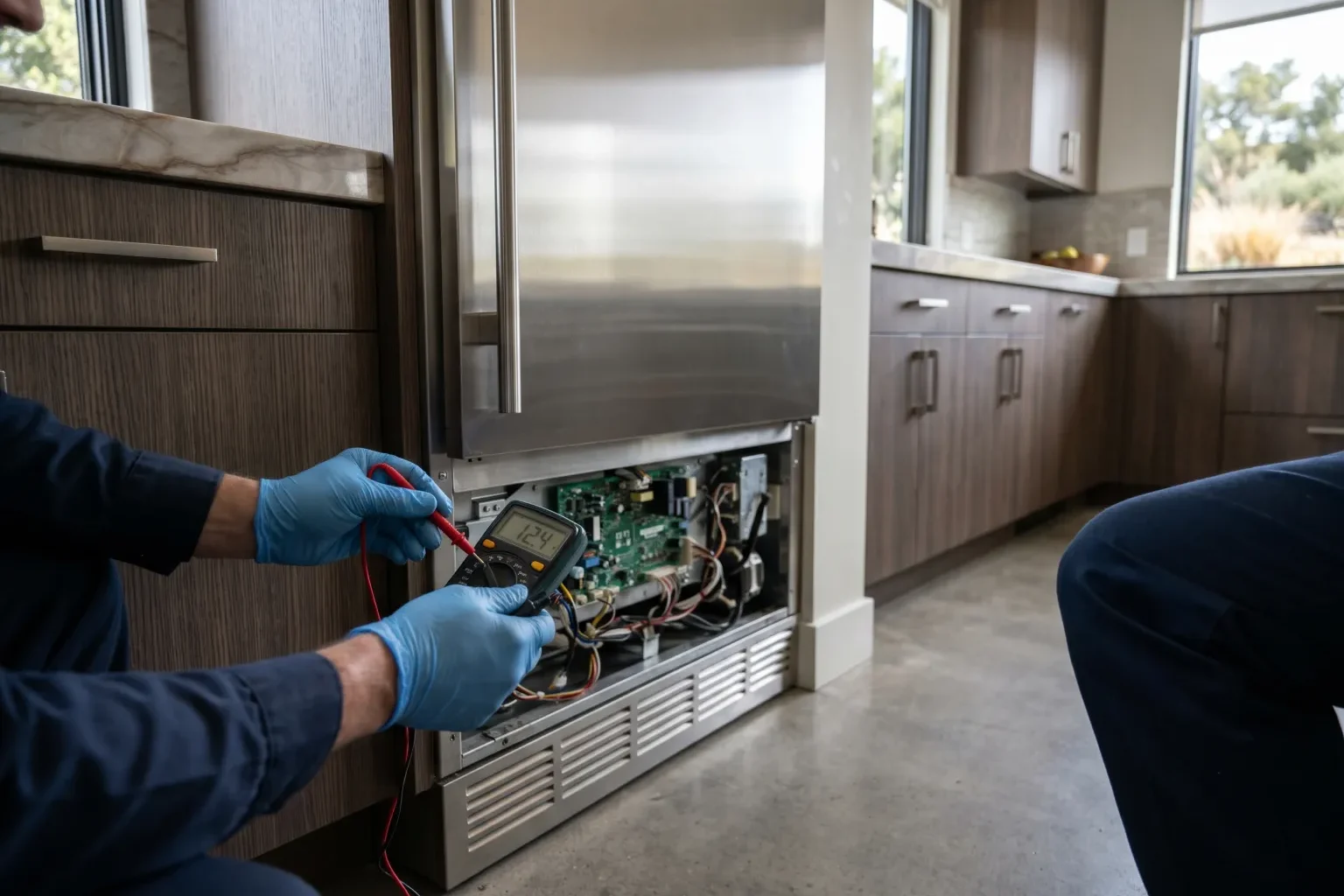
What our technician checks on a built-in cooktop
On a gas cooktop or rangetop, we start with the parts you can see. We check whether the burner caps and bases are seated correctly, whether the ports are clear, and whether the igniter electrodes are clean and intact. From there, we test the spark module, the ignition switches behind each knob, and the wiring between them. Moisture from a boilover or a wet cleaning is a common cause of non-stop clicking. We also check the burner valves, the pressure regulator, and the gas supply, and we look at flame size and color on every setting.
On induction and electric units, we confirm the cooktop is getting correct power at the connection. Then we test the control board, power boards, induction coils or heating elements, and temperature sensors. Induction cooktops depend on airflow, so we check the cooling fan and make sure cabinetry, drawers, or stored items below aren't blocking the vents.
Built-in installations add a few more checks. We look at clearance under the counter, how the unit is secured in its cutout, and whether it can be lifted out for service without disturbing stone or custom panels.
How Wolf, Viking, and Thermador cooktops differ
Wolf gas cooktops and rangetops use dual-stacked sealed burners, with an upper tier for high heat and a lower tier for simmering. When food or cleaner gets into the lower ports, the low flame can turn weak or uneven, or the igniter may keep sparking. Wolf induction models are more likely to have trouble with touch controls, cooling fans, and power electronics. Many households pair Wolf with Sub-Zero refrigeration, and we're familiar with how those kitchens are built.
Viking gas cooktops and rangetops have heavy grates and high-output burners. The usual failures are igniters, spark modules, and the switches behind the control knobs, which wear out with daily use. On older Viking units, we check parts availability early so you know your options before committing to a repair.
Thermador gas cooktops use the star-shaped burner, which has many small ports that need to stay clear for an even flame. The ExtraLow simmer feature turns the flame off and back on by design, which owners sometimes mistake for a fault. We'll confirm whether the cycling is normal or a sign of a real problem. Thermador induction cooktops, including the Freedom surfaces, tend to have issues with controls, sensors, and electronics rather than with burners.
Tell us what your appliance is doing.
Repair or replace a high-end cooktop
Repair is usually the better choice for a premium cooktop. Igniters, spark modules, switches, valves, sensors, and fans are replaceable parts, and a well-built gas or induction unit can keep working for many more years once they're fixed. Replacing the whole unit can also mean matching an existing countertop cutout, gas or electrical hookup, and ventilation, which can turn a simple swap into a larger project.
Replacement becomes worth considering in a few cases: when a major control or power board is no longer available, when the glass-ceramic top is cracked and replacement glass can't be found, or when several expensive components are failing at once. If we see any of these, we'll say so and walk you through both paths.
What affects the cost of a cooktop repair
Every repair is priced after diagnosis, and you'll hear the price before any work starts. Several factors shape it. The fault matters most: cleaning and reseating a burner takes less time than replacing a valve or an induction power board. Parts vary widely, and electronic boards and specialty burner assemblies cost more than igniters or knobs. Access also plays a role. A cooktop set into stone with tight cabinetry below, or one that has to come out of its cutout, takes more labor than a unit with open access underneath. If a part needs to be ordered, we may need a second visit to install it.
How a visit works
When you contact us, tell us the brand, the model and serial number if you can find them, and what the cooktop is doing. That helps the technician bring likely parts. At the appointment, the technician inspects and tests the unit, explains what failed and why, and gives you the repair price. If you approve, we complete the repair on the spot when the part is on hand, or we order it and schedule a return visit. Before leaving, we test every burner or zone on several settings and show you anything you can do to prevent the problem from coming back, such as cleaning burner ports or keeping induction vents clear.
Cooktop Repair by city
-
 Cooktop Repair in San Fernando
Local service & repairs
-
 Cooktop Repair in Burbank
Local service & repairs
-
 Cooktop Repair in Beverly Hills
Local service & repairs
-
 Cooktop Repair in West Hollywood
Local service & repairs
-
 Cooktop Repair in Hidden Hills
Local service & repairs
-
 Cooktop Repair in Calabasas
Local service & repairs
-
 Cooktop Repair in Glendale
Local service & repairs
-
 Cooktop Repair in Los Angeles
Local service & repairs
-
 Cooktop Repair in Santa Monica
Local service & repairs
-
 Cooktop Repair in Culver City
Local service & repairs
-
 Cooktop Repair in Santa Clarita
Local service & repairs
-
 Cooktop Repair in La Cañada Flintridge
Local service & repairs